1001 Uses For Dental Floss #34 – Chewing On Strange Floss

In 1819, New Orleans dentist Levi Spear Parmly published his book, A Practical Guide to the Management of the Teeth. In the book, he recommended that people use waxed silk thread to clean between the teeth “to dislodge that irritating matter which no brush can remove, and which is the real source of disease.”

Floss has come in many variations: thick, thin, waxed, unwaxed, flavoured, and unflavoured. But there have been some truly unusual attempts, as I’ve mentioned before: floss with nicotine, and made from nylon, silk (originally but not any more), polytetrafluorethylene (AKA GoreTex™ or Teflon™), and a number of “natural” or “organic” floss materials, generally made of silk, promising to be non-GMO, vegan, vegetarian, and gluten-free. They could also claim to be free-range, cruelty-free (although silkworms probably wouldn’t agree, if anyone were to ask them), cholesterol-free, and non-radioactive, too. Oh, and while we’re at it, no trans-fats either.

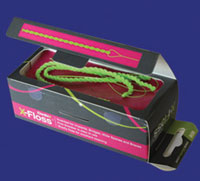
I came upon a different sort of floss recently in my journeys across the World Wide Web. It’s X-Floss by Idontix. (This is not a paid commercial.) Invented by a dental hygienist, Lise Slack, originally from South Africa, it comes in two forms, either a very, very thick yarn or a very, very wide gauze ribbon, (and “lite”, of course) which the company claims can be used to clean very wide spaces where teeth have been lost, below bridges, around implants, or behind the last tooth in an arch, but the really wonderful thing about this floss is that the Australian company iDontix sponsors a charity, http://www.i-hope.org.au/, which rescues orphans all around the world, so a sincere hooray for them. Not many companies can tout that in their literature.

1001 Uses For Dental Floss #33: Setting A Guinness World Record

Some people will do just about anything to become “famous”.

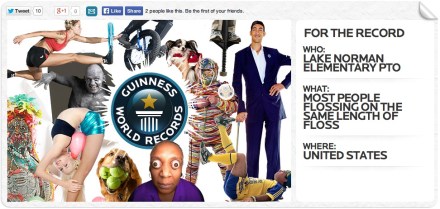
A total of 1,470 people comprising students, parents and teachers from Lake Norman Elementary School and Brawley Middle School (USA), flossed their teeth for 55 seconds on a single line of dental floss measuring 1,828.8 m (6,000 ft) at Lake Norman Elementary School, Mooresville, North Carolina, USA on 19 March 2004. The event was organized by the Lake Norman Elementary Parent Teacher Organization. Doesn’t sound very sanitary. I hope they didn’t try to flush it afterwards.

But don’t go away, there’s more. There are Guinness World Records for pretty much everything under the sun, and even a few things that the sun never shines on. For the dental floss and general dental obsessives out there, here are Guinness World Records for:

The largest toothpick mosaic: The largest toothpick mosaic was 40.521 square metres (436.16 square ft) and was created by the students of Tsugeno High School (Japan). It was finished and presented in Aichi, Shinshiro City, Japan, on 5 October 2008. All 229 students of the school participated in creating the mosaic, they used a total of 1,620,840 toothpicks in seven different colours.

The largest toothpaste tube: The largest tube of toothpaste measures 2.957 m (9.7 ft) long and weighs 780 kg (1,719 lb). It was made for the Zhonghua toothpaste brand by Unilever in Shanghai City, China and was unveiled on 20 September 2005.

The oldest person to grow a new tooth: The oldest person to grow a wisdom tooth: Brian Titford (b. Australia, 14 January 1933) had two upper wisdom teeth erupt at the age of 76 in March 2009. The new teeth were extracted to re-establish a stable denture. Mr. Titford’s dentist is Dr. Peter Klein of Cheltenham, Victoria, Australia.

The widest human tooth extracted: The widest human tooth was extracted from nine-year-old Shane Russell (Canada) on 28 June 2000. The tooth measured 1.67 cm (0.6 in) wide. The average width of a natural maxillary central incisor is 0.892 cm (0.3 in). The tooth has a length of 2.05 cm (0.8 in).

The longest line of toothpaste tubes: The longest line of toothpaste tubes is 1,688 and was created by Procter and Gamble Oral Care in Evian-les-Bains, France, on 26 June 2014.
The smallest tooth extracted: A primary tooth (tooth E) extracted under local anaesthesis from Colton Laub (USA) on 30 October 2002 by Dr. Scott Harden (USA) at Fountain View Family Dentistry, Acworth, Georgia, USA, measured 3mm (0.1 in) long. The average length of a microdont tooth is 13 mm (0.5 in).

The longest milk (AKA baby) tooth: The longest milk tooth is from Ahmed Afrah Ismail (Maldives) measuring a total of 2.3 cm (0.91 in) having a crown length of 1.0 cm (0.39 in) and a root length 1.3 cm (0.51 in). The tooth was measured in Male, Republic of Maldives on the 28 December 2000.

The largest collection of toothbrushes: Grigori Fleicher (Russia) has a collection of 1,320 different tooth brushes as of 5 November 2008.

The largest toothpaste tube collection: The largest collection of toothpaste tubes is 2,037 and belongs to Val Kolpakov (USA), in Alpharetta, Georgia, USA, on 15 June 2012.
The oldest milk tooth: The oldest milk tooth belongs to Joyce Walen (b. 8 January 1927) of Capitola, California, USA, who still retained a deciduous tooth (upper left H) as of 25 February 2014, at the age of 87 years 48 days.

The largest toothpick sculpture: The largest toothpick sculpture is an alligator named Alley, made by Michael Smith (USA), which contained over 3 million toothpicks, was 4.5 m (15 ft) long, and weighed 132.4 kg (292 lb) when measured at Galvez Middle School, Prairieville, Louisiana, USA on 22 March 2005.

The longest human tooth extracted: The longest human tooth extracted measured 3.2 cm (1.26 in), which was removed from Loo Hui Jing (Singapore) in Singapore, on 6 April 2009. The procedure took place at the Eli Dental Surgery and performed by Dr. Ng Lay Choo.

The smallest tooth ever extracted: A primary tooth (tooth E) extracted under local anaesthesia from Colton Laub (USA) on 30 October 2002 by Dr. Scott Harden (USA) at Fountain View Family Dentistry, Acworth, Georgia, USA, measured 3mm (0.1 in) long. The average length of a microdont tooth is 13 mm (0.5 in).

The youngest person to have a wisdom tooth extracted: Matthew Adams (USA) (b. 19 November 1992) had his lower two wisdom teeth removed due to lack of space at Midland Oral and Maxillofacial Surgery, Michigan, USA, on 24 October 2002 when he was aged 9 years 339 days.

The most toothpicks rotated in the mouth simultaneously: The most toothpicks rotated in the mouth simultaneously are 35 and were achieved by Stefano Goina (Italy) on the set of Lo Show dei Record in Rome, Italy, on 11 March 2010. The record was part of the Italian TV show “Lo Show dei Record”.

1001 Uses For Dental Floss #32- Surviving The Apocalypse

Dr Strangelove, greatest conspiracy theory comedy film ever.

The world is coming to an end. The asteroid is about to crash into our planet, zombies are everywhere, the second coming is coming, and the Russians are invading. You’ve decided to run away into the deep woods and survive there and be the last outpost of civilization as we know it.

So, what to bring that might may make things better for you? Dental floss, of course. A number of websites devoted to post-apocalyptic survivalists list floss among the items that any good conspiracy theorist should have in their Humvee before they take off from the suburbs.

Floss can be used for fishing line, to make a miniature bow and tie points to the arrows, tie a splint around a broken leg because it’s so very strong. It can tie down a tent flap, make a snare to catch small animals for food (if you’re not a vegetarian), tie it to two handles and using saw-like motions, cut through meat (cooked is easier), cheese, and other foods. And if you’ve got enough, and are good at macramé, you might be able to weave a web out of it to make a bag for carrying things. So be sure to get to your pharmacy or dollar store and buy up their whole supply. You never know when there won’t be any more around.

For the funniest article I’ve seen about floss and the Big Conspiracy, go to:

Oppose “Big Floss”; practice alternative dentistry

1001 Uses For Dental Floss #31- The Grand Unified Field Theory and Dental Floss

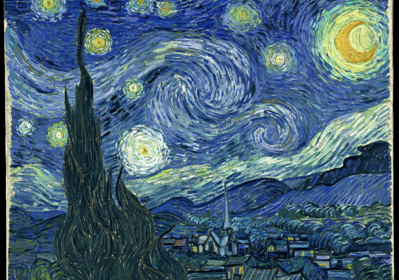
Starry Night by Vincent van Gogh

In a fascinating article in New Scientist (well, I find it fascinating), http://www.newscientist.com/article/dn19043-aspirin-and-dental-floss-homespun-highenergy-physics.html#, pretty everyday things are being used as part of various cutting-edge physics experiments at labs like Fermilab on the French-Swiss border, the Large Hadron Collider near Geneva, Switzerland, and the National Institute of Radiological Sciences in Tokyo, Japan in experiments to test the limits of space, time, energy, and matter.

Reminding us of the Steven Spielberg film E.T., where a cute little alien stranded on Earth was trying to build a device to “call home”, and put together various “borrowed” objects to that end, our planet’s scientists are using ordinary items, which include aspirin tablets, recycled plastic bottles, fishing line, aluminum foil, Japanese konnyaku noodles, model airplane servomotors, stockpots, and even a coffin. Simply amazing! And one of these items is–you guessed it–dental floss, which is used to tie down very fine wires to keep progressively colder layers from touching and so absorbing heat in the Cryogenic Dark Matter Search detector in Minnesota, to keep its core at one degree above absolute zero (as cold as things can ever get).

You won’t ever try this at home, so no warning is necessary, but if an alien ever knocks on your door one night and asks for some dental floss, you’ll know why. I suggest you give it to him (or her).

1001 Uses For Dental Floss #30- Cats and Floss

Pets can take a toll on you, especially when they get sick. This is the story of Stanley, the cat, who lives with its “parents” in Philadelphia, PA, back in 2002. It seems that this 5-year-old cat became very ill one evening, throwing up numerous times, as cats sometimes do. In this case, though, the vomiting continued on and on, late into the night, so that by midnight the decision was made to bring Stanley to a pet hospital. There, an x-ray ($500) revealed nothing, and he was sent home. The next day, at Stanley’s regular veterinarian, who noticed the cat’s intestines were beginning to “accordion”, not a term I’m familiar with, but a fairly graphic description that, with some imagination, you can probably visualize.
Afraid that this would lead to perforation and imminent death, surgery was ordered ($1600). What came out was a 2-foot length of dental floss that Stanley had somehow swallowed.
Did he think it was a long version of cat hair? We tried to interview him, but he wasn’t talking–probably too embarrassed. The owners had been dropping their used floss in the bathroom garbage can, which is, if you remember, a good way of keeping it from clogging the sewage pipes if it’s flushed away, as happened in Toronto (see Use # 12- April 17, 2014).
So this misadventure with floss cost this family $2100 (apparently equivalent to $3400 in today’s dollars, or about $5 million dollars in Canadian funds). And pet health insurance isn’t covered by Obamacare, as it is in Canada.
At this very moment, then, the residents of Philadelphia are waiting for their sewage system to collapse, as the habit of flushing floss spreads through that city. (Say “flushing floss” 10 times quickly for more fun).

1001 Uses For Dental Floss #29- Flossing While Driving

So you thought texting and driving was a dangerous mix. This story would probably strike most of us as a not very endearing use for floss, even gruesome, but this is a pretty intricate story.

A man driving his Toyota Prius along the superhighway in Connecticut was killed in a
bizarre and gruesome accident, or so it seemed (to be an accident, that is). According to the police report, the man was flossing his teeth with a floss pick while driving. It seems his car was rear-ended by a large pickup truck, causing the airbags to deploy. The force of impact between the airbag and the dental pick apparently drove the dental hygiene tool through his tissues into his skull, killing him.

Stop right now, you’re screaming, I don’t want to hear any more. But you do, don’t you?

The deceased seems to have had two passions in life, the environment (hence the Prius, which requires very little gas to run), and oral hygiene, to the point of being a compulsive flosser (like spending a large part of his waking time actively flossing his teeth). And guess who resented not being included in love triangle? His former girlfriend. She seems to have developed quite a resentment at being second fiddle to a bit of floss. And guess who was driving the pickup truck that rammed into the deceased’s car? It was this woman.

It seems, according to a police spokeman, that she knew his habits, knew he would be flossing while driving, and deliberately rammed him hard enough to kill him. THe report doesn’t say whether there was enough evidence to arrest and try the girlfriend, so maybe not, so we’re left wondering: Did this really happen?

If this was a game of Clue, would it be the former girlfriend in the pickup truck with the floss?

And the morals of this sad tale? Don’t floss and drive. Don’t floss so much that you drive love out of your life. And don’t floss so much that the love of your life drives the floss into you.

1001 Uses For Dental Floss #28- Fishing For Loot

Photo ©Angel Chevrestt

Puerto Rico native Eliel Santos makes a living by reeling in jewelry, cash and electronics from beneath New York City’s sidewalk grates. Every day, he visits various parts of the Big Apple, and using dental floss and mouse trap glue, he manages to retrieve a variety of loot lost through the sidewalk grates. The urban treasure hunter peers through the small metal holes hoping to spot something worth pawning. When he notices something, he positions himself over his find and uses his tools – a line of dental floss attached to different size weights covered in mouse glue. He carefully lowers his sticky line through the grating into the darkness below and snares his booty.

Sometimes it’s just quarters. Many times, though, Santos has pulled up precious jewelry, cash and gadgets like iPhones or iPods. 

Santos started his unusual retrieval business by chance. While walking down the street, he noticed that a man had dropped his keys down a grate. Santos went up to him and offered to help. After buying a sticky mouse trap at a nearby store, he attached it to a rock and tied it with string. After lowering it 15 feet through the grating, he recovered the keys and was rewarded with $50. That’s when he realized that this was a good way to make money. He started hunting in various parts of the city, looking through the grate holes for valuable items. His best catch so far was an 18k gold and diamond bracelet, which he pawned for $1,800. Once he helped a guy get back his wedding ring and was rewarded for that good deed.

On good days, Mr. Santos makes around $150, but on great days he can walk away with over $1,000. He’s retrieved many an iPhone in Times Square. It seems people often drop them while texting and walking. Most don’t even bother to try and get them out, but he does. On the day New York Post reporters followed him on one of his daily hunts, Santos found a green iPod Nano, a fake gold necklace and a pocket full of change. A good day’s work. And a good way to use dental floss. The reporter for this news piece forgot to ask Mr. Santos if he flosses, but I bet he does. Don’t you forget what you should really use it for every day.

Urban Treasure Hunter Makes a Living Retrieving Stuff People Drop on the Street

1001 Uses For Dental Floss #27- Civic Engagement

Photo by Harry Rajchgot

Kudos to the City of Cote St. Luc (Quebec, Canada) which today handed out hundreds of free tomato plants to its enthusiastic citizens as its way of encouraging city farmers to raise home-grown food in their own backyards and the city’s garden plots. Fresh, tasty and nutritious fare mere footsteps from the back door; who can ask for better?

And how can you support a tomato plant and keep it from falling or being knocked over by a gust of wind or the neighbour’s cat? Dental floss, of course (see photo). Another useful use and a small part in citizens’ civic engagement in the vitality of their neighbourhoods.

1001 Uses For Dental Floss #26- Floss Guitar

So after all that religion in #25, let’s lighten up a bit with this simple and entertaining video by Euan Dobson, showing us how he strings a classical guitar with dental floss. Listen to how beautiful it sounds. Cool!

<https://www.youtube.com/watch?v=HO08T4ukuac&gt;

1001 Uses For Dental Floss #25: Oral Hygiene And Religion

Religion and Oral Hygiene

I know I’m going to get into trouble with someone here. Although it’s said that we shouldn’t discuss religion, sex, or politics over dinner, is that admonition still true in front of the bathroom mirror? Doing a study of comparative religion based on differences in attitudes to oral hygiene may not say much about those religions in general, or perhaps may be instructive of differences in world views and attitudes. Well, here goes. Please don’t take offence.

1. Islam

In Islam, wudu (ablution) is required before prayer (5 times a day) or the reading of the Quran, and one of these recommended forms of wudu is the cleaning of the teeth using a piece of fragrant wood (miswak) from the arak tree. If that is unavailable, the use of a toothbrush and a toothpaste prepared according to Islamic principles is an acceptable substitute, and even that not being at hand, the teeth can be cleaned by rubbing them with clean fingers and rinsed with water. So Islam definitely gets credit for promoting good oral hygiene.

2. Judaism

More admonition than promotion here. Jewish law is interpreted in terms of certain acts being permitted or not during shabbat (the Jewish Sabbath) and certain holy days.

Thus, there are comments by some rabbis about brushing, flossing, and tooth paste. For Orthodox Jews, on Shabbat it seems that toothpaste is not permitted as squeezing the tube could be interpreted as sculpting, which is not permitted during that period. Also a dry brush should be used, and it shouldn’t be rinsed afterwards. Hardly a hygienic way of dealing with the biological problem of disease bacteria. Some variance allows the use of a liquid tooth cleaning solution.

On Yom Kippur, brushing is forbidden for 26 hours.

One of the important principles is not to cause bleeding, so a soft toothbrush is suggested. However, bleeding is caused by gum inflammation which is the result of plaque bacteria not being adequately removed. Good brushing and flossing technique would result in healthy gums and no bleeding. Definitely a low mark for oral hygiene practices in Orthodox Judaism.

On the other hand, when asked if a woman going to the mikveh (ritual bath) must floss before immersion, the answer is yes, to remove particles of food between the teeth. The principle here is that the woman should be as clean as possible before immersion. There was even a suggestion by one rabbi that it would be better to floss regularly to prevent a “mishap” before entering the mikveh. Presumably, although my interpretation could be wrong, this refers to bleeding from the gums if a woman only flosses at the occasion of using the mikveh and not on other days. So at least in this case the Orthodox advice may be consistent with good oral hygiene.

Christianity:

A bit obscure. The analogy of dental hygiene and specifically flossing are cited as a way of understanding the relationship between God, suffering, clarity in one’s faith and our relationship to good deeds that are unrewarded in our lifetimes. Blake Hart, a Christian missionary living in Chile, uses the contradictory results of his good oral hygiene and poor dental record and contrasts that with his wife Bekah’s inconsistent flirtation with adequate oral care and her great results at the dentist’s office. Life is unfair. Why? Ask Job, he says.

See his blog at http://recoveringseminarian.wordpress.com/2013/02/20/toothbrushes-and-job/

One of the posts in the blog “The King’s Dale”, which is about Christian matters from the perspective of what seems to be an evangelical Protestant, is titled “Dental floss for the brain”, which I found a little intriguing, since the connection between God and dental floss doesn’t at first spring to mind, or at least not mine, except if we remember the homily that cleanliness is next to godliness.

The author of that blog was flossing his teeth when the image of all the disgusting dangers that lie hidden in between the teeth came upon him. He felt that “many Christians whose lack of interest in studying Scripture in-depth is akin to not wanting to floss.” This, he feels, is an immaturity in the faith which presents dangers when life difficulties happen, and the resultant ignorance leads to spiritual disease. So the study of the The Word would prevent false doctrines festering in the recesses of the mind, leading to the need for some spiritual mental/dental hygiene, I suppose, and if allowed to go on, to the need for a spiritual root canal treatment, gum surgery, or ultimately, a spiritual extraction.

I told you I would have to be careful here. On the surface, though, the author of the blog definitely advocates flossing.

Dental floss for the brain


Dental floss for the brain

A bit obscure.

I came across one question on a Catholic forum about whether oral hygiene is permissible during the Eucharistic mass. Unanswered and obscure.

Hinduism and Jainism:

Most Hindus have a ritual of cleanliness and prayer each morning, which includes brushing the teeth, followed by bathing, prayer and then eating. Oral hygiene is very important to most Hindus, especially those who practice ayurvedic principles.

Many Hindus prefer to brush their teeth immediately after waking in the morning and some may also scrape their tongue with a metal tongue scraper. This is done to avoid the ingestion of impurities that may have built up in the mouth during sleep.

Hindu Brahmins and priests, especially in the region of Varanasi (Uttar Pradesh, India) clean their teeth using cherry wood twig for an hour, facing the rising sun. They must have very clean teeth after that, and maybe even gum trauma. Orthodox Jains clean their teeth using only their fingers and without using the brush.

Chewing sticks or twigs derived from many plants are used in many religions and cultures, and some have antimicrobial properties. Twigs offer mechanical cleaning action.

The rural folk in Udupi region of Karnataka in India use the twigs from mango or cashew tree. Neem and banyan twigs are commonly used in the rural areas of Tamil Nadu, coconut twigs in the rural areas of Kerala. Datun is used in North India. In African countries, twigs from salvaodora persicca are used, and they seem to have a high concentration of fluoride, which may offer anticaries action that add the the benefits of cleaning the teeth.

Buddhism:

The Chinese have long been paying special attention to dental health. They started oral hygiene and oral care way back in ancient times. The earliest toothbrush was introduced into China with Buddhism. It was a poplar branch with one end made into the shape of a brush, used to clean the teeth when dipped in medicine or aromatic herbs. Some people would clean their teeth by just chewing tender poplar or willow branches.
In the Southern Song Dynasty, mass-produced toothbrushes were available on the market. The toothbrushes were made of bones, horns, bamboo, wood and other materials, with one end having two lines of drilled holes for hair fixing. The hair was made of horsetail. The toothbrushes were similar in outward appearance to their modern-day counterparts.

Gargling was the most common way of mouth rinsing in ancient times. The earliest gargles include wine, vinegar, salt solution, tea, and water.

An early form of medicated tooth paste was recorded in the Taiping Holy Prescriptions for Universal Relief compiled under the commission of Emperor Taizong of the Song Dynasty: the paste obtained by boiling and concentrating the sap of willow branches, Chinese scholar tree branches and mulberry branches are mixed with ginger juice, and the root of Chinese wild ginger can be used to clean the teeth.

American Native Religion:

The Inca of Peru and the Aztec of Mexico used the toothbrush as early as the year 1000 AD. The Inca made their toothbrushes from a Molli tree and the Aztec took a twig from a plant they called tlatlauhcapatli. The plant had astringent properties, which cleaned the teeth but also tightened the gums and freshened the breath. Aztec dentists prescribed salt water as a mouth rinse.

Mouthwash used by North American natives was derived from the gold thread plant, which contains berberine, an alkaloid similar to nicotine and morphine in its effects. Witch hazel was another source. Precontact American Indians valued dental care and good mouth hygiene.

Scientology:

I read one letter that stated that the writer was a scientologist and cured her cavities through hypnosis, but this could be a tongue in cheek comment.

Homeopathy:

Not technically a religion, although believing it requires a lot of faith, but I can’t resist. What is the homeopathic way of rinsing the teeth clean? It can’t be done. The more you rinse, the dirtier the teeth get. Think about it.

Atheism: I read one claim that atheists floss. Why?

Devil worship: Another individual claimed that she made a pact with the devil that granted her clean teeth that don’t require brushing and flossing. Good luck.

Verrily, some of these citations are of questionable validity, but you gotta have faith.

But floss anyway. Believe me.